
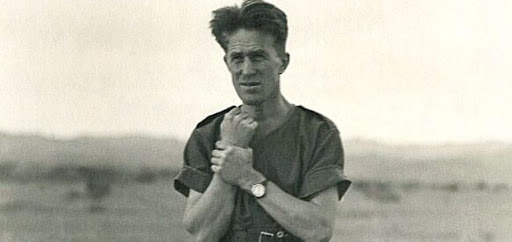
Last night I read 4 “chapters” of The Mint by T.E. Lawrence. I put chapters in quotes because those 4 sections amount to only about 8 total pages of reading. It’s obvious to me that this book is going to be fascinating both in subject and in diction. I honestly don’t know how well this book might translate into a one of my “Book Club” blog posts or even if trying to would lessen the experience of reading it. Content may be the product of the internet but if the most engaging way for me to read a book is to simply read it myself then I should obviously forgo the potential content of clickable blog posts in pursuit of that better experience. I don’t just say that because my blog posts get zero clicks anyway so I might as well look cool in a sort of, “Well, as long as I’m hooked I might as well volunteer” attitude. Basically what I’m trying to say is that I might not post this that I am currently typing out but I’ll instead just use this to write down anything I feel like and afterwards I’ll see how it looks and if I can make anything out of it.
Is there anything I want to say about the first 4 sections? First off, I gotta figure out a better way to refer to each section rather than switching awkwardly from “chapter” to “section”. So, the book itself is divided into “Parts” which are further divided into separately numbered and titled chapters. I guess I’ll format references this way, “Part: chapter number; and then possibly chapter title”. Don’t ask me why I’m using that punctuation because I don’t have a good answer and I don’t care. Is that how the they do bible versus? Like, 3:6?
Anyway, the three things that stood out in 1:1-4, were the writing itself, as in the word choice and sentence structures, the simply unique nature of the book’s existence as something that is unlike all others, and my own new experience of reading someone else’s diary.
When I say diary I don’t mean to imply that this book’s purpose was simply a diary. Clearly it’s more than that but I don’t read much non-fiction. I can’t remember ever reading an autobiographical work or even a regular non-fiction book. Have I ever even read a legit book on history? Basically it’s weird for me to know that the things being described in words actually happened and that the characters are real people that the author has zero control over. I mean, they’re obviously being represented by Lawrence so he does have some control but not in the way a Director has control over how a famous historical figure, such as Lawrence himself, is portrayed, the words he chooses and the overall personality of each character. It’s new for me to read dialogue without considering why the author is making each word choice for each character.
The second of the three “things” actually compounds on top of the newness of the third. This book is incredibly unusual. While T.E. Lawrence himself is obviously unusual the book itself is essentially impossible to categorize or equate with. Maybe I could best show this with a list, a list of aspects of rarity.
- The author is a hugely famous war hero of WW1.
- Those heroics were extremely different from typical war heroics.
- The man himself was extremely unique. A quote on the cover is from Winston Churchill, “I deem him one of the greatest beings alive… we shall never see his like again.”
- This war hero decided to re-enlist, twice, into the military under fake name with an idea to turn his experiences and journals into some sort of novel. That’s a premise I’ve never seen the like of even in fiction.
- So far, it seems the experiences are not edited into some sort of narrative directed towards a goal but rather the intermittent journaling of whatever this unusual man felt was important to write down. That’s way I referred to it as a diary rather than a book because it’s more of a direct look into the soul of the man himself without the potentially opaque window of the novel.
- The author died before being completely “finished” with the work and even before his death he wanted the book to not be released until 1950.
These two “things” compound because this isn’t the “Commentarii de Bello Gallico” or some other autobiographical or non-fiction work that is meant to describe events so that people know what happened or, maybe in Caesar’s case, what the author want’s us to think happened. The Mint is more of a mix between expose, poetry, self-exploration, journal, and uncertainty. Obviously, whatever kind of book it is, it is unusual to at least me.
The first of the three “things” that stand out is the writing itself. The way Lawrence writes is… well… I guess the word I would use is “free”. There seems to be no notion of adherence to any normal writing rulesets. This type of writing, regardless of my complete inability to define the ‘type’, is exactly the type that appeals to me. Really, I think “Free” might be the best word for it. Not free in the sense that it is without control but free in the sense that brilliant, extensive, and clear amount of control is all coming from the authors commitment to only his desire to express. Even a direct rebellion against the established rules of expression is still entirely slave to those rules. This type of writing feels free in that rebellion or adherence or conformity are hardly even considered.
I guess I wrote a whole blog post instead of just reading the freaking book.
 The Mind of Joshypoo